

As climate change leads to an increase in instances of flooding, the need for temporary flood barriers increases. Owners of infrastructure and engineers/designers that work with owners and contractors are seeking cost effective flood protection solutions that can be deployed and be operational in a very short period of time. They also are seeking solutions that can withstand extreme hydraulic loads as well as provide long term durability and strength over the structure’s life.
Among modern flood protection solutions aluminum flood walls are favored by airports, subway stations, industrial parks, power substations and commercial buildings. The modular construction allows for a very fast installation. The material is resistant to corrosion.
Although the main decision in large-scale infrastructure projects is the choice of flood barrier products, selecting the appropriate supplier to deliver consistent structural performance, verified engineering data and manufacturing quality on a continuous basis for all stages of the project is a far greater challenge.
As a guide to evaluating aluminum flood wall suppliers from an infrastructure engineering perspective, this guide covers a number of factors including materials, performance, standards, manufacturing and durability.
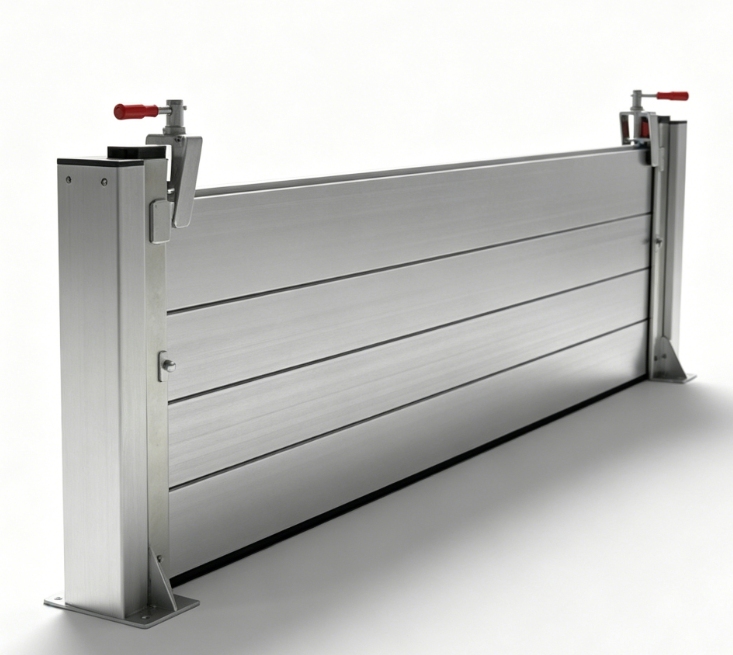
Why Are Aluminum Flood Walls Widely Used in Infrastructure Protection Projects?
Lightweight construction, high strength and modular installation make aluminum flood walls the standard solution in modern flood-mitigation.
What Makes Aluminum Flood Barriers Structurally Advantageous?
The typical material used for Aluminum flood wall designs are marine-grade or structural aluminum alloys, which include for example 6063-T5 or 6082-T6.
- High strength-to-weight ratio
- Excellent corrosion resistance in humid and coastal environments
- Long-term structural stability under cyclic loading
- Low maintenance requirements compared to steel systems
Unlike permanent concrete flood barriers aluminum systems are modular, can be removed if required and are suitable for both emergency situations and long term infrastructure applications.
Where Are Aluminum Flood Walls Typically Installed in Infrastructure Projects?
In global engineering projects aluminum flood barriers are commonly used in:
- Airport terminals and runway access tunnels
- Metro and subway entrances
- Power substations and transformer yards
- Water treatment and pumping stations
- Industrial parks and logistics warehouses
- Coastal commercial buildings and underground parking systems
These environments require fast response to floods, and as little disruption to normal operations as possible.
What Defines the Engineering Quality of an Aluminum Flood Wall System?
For the procurement teams of infrastructure projects, the technical quality of flood protection barrier systems has to be checked against parameters of structural engineering and not against other criteria such as appearance or price.
How Is Structural Load Capacity Calculated in Flood Wall Design?
Design of flood barriers is based on hydrostatic pressure load calculations.
- Water height (H)
- Flow velocity impact
- Barrier span width
- Anchor system strength
To test these structures within FEA simulations of real-world flood scenarios engineers can check for stability under peak pressure.
A properly engineered aluminum flood wall must resist:
- Lateral water pressure deformation
- Frame bending under sustained load
- Leakage at sealing interfaces
What Material Standards Are Required for Reliable Performance?
High-quality flood barrier systems typically use:
- EN AW-6063 T5 / T6 aluminum profiles
- Marine-grade anodized surface treatment
- EPDM rubber sealing gaskets
EPDM seals are critical because they ensure:
- Zero-leak watertight performance
- Long-term elasticity under temperature variation
- Resistance to UV and chemical exposure
Even the strongest aluminum structures can fail when exposed to long-term flooding if they do not have a proper sealing system.
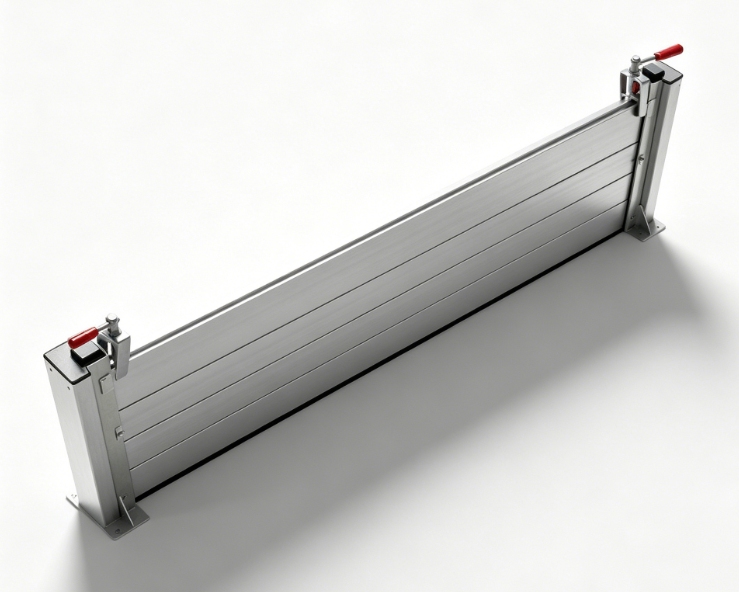
How Do Manufacturers Ensure Quality Consistency in Flood Barrier Production?
When it comes to manufacturing on an infrastructure scale, consistency is far more important than the performance of any individual item.
What Happens Inside a Flood Wall Manufacturing Factory?
A professional aluminum flood wall factory typically includes:
1. CNC Precision Extrusion and Cutting
Aluminum profiles are cut using CNC-controlled systems.
- Dimensional accuracy
- Perfect modular alignment
- Interchangeability across panels
2. Welding and Frame Assembly
Structural frames undergo:
- TIG welding for joint stability
- Flatness calibration
- Stress point reinforcement
3. Surface Treatment Process
To enhance durability, manufacturers apply:
- Anodizing for corrosion resistance
- Powder coating for UV protection
- Anti-scratch finishing for long-term use
4. Sealing System Integration
EPDM sealing strips are fitted with fixed force to ensure correct fit.
- Uniform compression force
- No micro-gap leakage paths
- Long-term elasticity retention
What Quality Tests Are Required Before Shipment?
Reliable suppliers conduct:
- Hydrostatic pressure testing
- Water leakage simulation tests
- Load deformation testing
- Installation alignment verification
- Surface corrosion resistance testing
Instead of a laboratory test these tests simulate real flood situations.
How Do Aluminum Flood Wall Systems Perform in Real Infrastructure Projects?
Typically, engineering procurement teams evaluate suppliers based on their performance during the field deployment of products rather than based on the product’s specifications.
Why Are Modular Flood Barriers Preferred in Urban Infrastructure?
Modular aluminum flood systems provide:
- Rapid deployment (typically 10–30 minutes per section)
- Flexible installation for irregular entrances
- Scalable protection length
- Minimal civil engineering modification
This makes them especially suitable for:
- Subway entrances that require seasonal protection
- Airport terminals with large entrance spans
- Industrial facilities requiring temporary flood defense
What Is the Difference Between Aluminum Flood Walls and Steel Flood Barriers?
| Feature | Aluminum Flood Wall | Steel Flood Barrier |
| Weight | Lightweight | Heavy |
| Corrosion Resistance | High | Requires coating |
| Installation Speed | Fast | Slower |
| Maintenance Cost | Low | High |
| Lifespan | 15–25 years | 10–20 years |
With modern infrastructure increasingly utilizing Aluminum systems due to lower lifecycle cost and fast tracking capabilities, we have expertise in using this material for numerous structures.
How to Evaluate an Aluminum Flood Wall Supplier?
Choosing a supplier to supply parts for your product is not just about choosing the cheapest supplier. It requires a structured engineering evaluation model.
Does the Supplier Have Engineering Design Capability?
A qualified supplier should provide:
- Hydraulic load simulation reports
- CAD/BIM-based design support
- Site-specific customization capability
- Structural reinforcement calculations
Does the Manufacturer Have Large-Scale Production Capacity?
Infrastructure projects require batch consistency. Key indicators include:
- ISO-certified manufacturing system
- CNC-based production lines
- Batch traceability system
- Standardized module design
Can the Supplier Support Complex Infrastructure Projects?
Strong suppliers typically support:
- Airport flood protection projects
- Municipal drainage systems
- Energy infrastructure protection systems
- Coastal defense engineering
Project references are critical to verify actual engineering ability.
Why Is After-Sales Support Critical in Flood Protection Systems?
Flood barriers are not just products. They are emergency infrastructure systems.
What Maintenance Services Are Required?
Professional suppliers should provide:
- Periodic seal replacement
- Structural inspection services
- Emergency deployment training
- Spare part supply systems
Even slight degradation of seals can cause a system failure during severe weather.
Why Is Training Important for Infrastructure Teams?
End users must be trained in:
- Rapid installation procedures
- Emergency response workflows
- Seal alignment techniques
- Storage and handling methods
Training and experience is key to having a system that is ready to respond in a real flood event.
Why Do Infrastructure Developers Choose Suppliers Like AquaBarrier?
Suppliers such as AquaBarrier offer engineered, modular flood protection systems for large-scale, infrastructure type applications within the global flood protection market.
Their systems typically include:
- Extruded aluminum modular frames
- EPDM high-compression sealing systems
- Pressure-tested panel structures
- Project-based customization engineering
Such suppliers act as full-fledged infrastructure engineering partners that enable the full end-to-end deployment of flood protection systems.
Conclusion
For large infrastructure projects, choosing a suitable aluminum flood wall supplier requires careful assessment of several criteria, including the supplier’s engineering capabilities, design criteria for the structural elements, consistent manufacturing quality and long-term functionality.
A high-performance flood barrier is more than a material. Performance is achieved by optimal integration of components.
- Hydraulic load engineering
- Precision manufacturing
- Sealing system performance
- Modular deployment efficiency
- Lifecycle maintenance support
When you are an infrastructure developer, airport, municipality or industrial party, you are not looking for a supplier of aluminum panels. You are looking for a supplier of a complete engineered solution for flood protection, which is able to realize its promises in case of a disaster.
FAQs
1. What is the typical lifespan of aluminum flood wall systems?
The life expectancy of high-quality aluminum flood barriers is between 15 and 25 years, depending on various external factors as well as usage and maintenance.
2. Can aluminum flood walls withstand high-pressure flood conditions?
Yes. Properly engineered systems are designed to withstand hydrostatic pressure loads calculated based on site-specific flood height and flow conditions.
3. Are aluminum flood barriers suitable for permanent installation?
Yes. Even though these solutions are modular and can be removed if required, they are often used as semi-permanent perimeter flood protection solutions for infrastructure projects.


