

Selecting the correct pipe clamp is not just about measuring a pipe. You cannot simply choose a clamp with a matching number on the label. Pipe specifications frequently rely on Nominal Pipe Size (NPS), Diameter Nominal (DN), and actual outside diameter (OD). These values refer to the same pipe. However, they represent different measurements. Picking a clamp based on an incorrect value can cause a loose fit. It might also lead to pipe movement, coating damage, extra noise, or installation delays. This guide clarifies how to match NPS, DN, and actual pipe OD for standard pipe sizes ranging from 1/2″ to 12″.
What Do NPS, DN, and Actual Pipe OD Mean?
Before you select a pipe clamp, you must identify the sizing system used. Check the project drawing, pipe label, or purchasing document. NPS and DN serve as nominal designations. Meanwhile, OD represents a physical measurement.
What Is NPS?
NPS stands for Nominal Pipe Size. It is an inch-based pipe designation. People commonly use it in North America and across many international industrial projects.
The term “nominal” indicates that the stated size acts as a standardized name. It does not reflect the exact outside diameter. For instance, an NPS 2 pipe does not measure exactly 2 inches across the outside. Its standard outside diameter is actually 2.375 inches. This equals roughly 60.3 mm.
NPS assists engineers, contractors, and suppliers. It helps them find compatible pipes, fittings, valves, and support products.
What Is DN?
DN stands for Diameter Nominal. It serves as the metric designation for pipes and related components.
Similar to NPS, DN does not provide an exact physical measurement. For example, NPS 2 usually matches DN50. Yet, the actual outside diameter of the pipe measures 60.3 mm instead of 50 mm.
People normally write DN values without adding a unit symbol. Therefore, a specification might display DN50 rather than stating “50 mm pipe.”
What Is Actual Pipe OD?
Actual pipe OD is the measured distance across the exterior surface of the pipe. It remains one of the most critical dimensions during pipe clamp selection. The clamp needs to fit securely around the pipe body.
If a clamp is too large, it might let the pipe move or rattle. If a clamp is too small, it might fail to close properly. This could harm the pipe surface or damage the clamp hardware.
Why Is Nominal Pipe Size Different from Actual Diameter?
Experts developed nominal pipe sizing to create a standardized system. This system identifies pipes and compatible components. The nominal number does not always equal the pipe’s physical diameter.
This variation is particularly significant for pipes ranging from NPS 1/2 to NPS 12. For these sizes, the actual outside diameter is larger than the given nominal size.
Does Pipe Schedule Change the Outside Diameter?
For a specific NPS, common steel pipe schedules typically share the same outside diameter. The schedule primarily alters the wall thickness and the inside diameter.
For instance, both NPS 4 Schedule 40 and NPS 4 Schedule 80 steel pipes feature an outside diameter of 4.500 inches. However, Schedule 80 possesses a thicker wall. It also has a smaller internal opening.
Consequently, a pipe clamp chosen for a bare NPS 4 steel pipe might fit both schedules. This is true as long as the clamp can handle the required load and application.
Different materials might adhere to distinct dimensional standards. Therefore, you should verify copper tube, plastic pipe, stainless steel tubing, and other products individually.
Which Pipe Clamp Size Matches NPS 1/2″ to 12″?
The following chart displays typical NPS-to-DN equivalents. It also shows standard outside diameters for steel pipe. You can use it as a helpful initial reference when picking a pipe clamp.
Pipe Clamp Size Chart
| NPS | DN | Actual OD in Inches | Actual OD in Millimeters |
|---|---|---|---|
| 1/2″ | DN15 | 0.840 | 21.3 |
| 3/4″ | DN20 | 1.050 | 26.7 |
| 1″ | DN25 | 1.315 | 33.4 |
| 1-1/4″ | DN32 | 1.660 | 42.2 |
| 1-1/2″ | DN40 | 1.900 | 48.3 |
| 2″ | DN50 | 2.375 | 60.3 |
| 2-1/2″ | DN65 | 2.875 | 73.0 |
| 3″ | DN80 | 3.500 | 88.9 |
| 3-1/2″ | DN90 | 4.000 | 101.6 |
| 4″ | DN100 | 4.500 | 114.3 |
| 5″ | DN125 | 5.563 | 141.3 |
| 6″ | DN150 | 6.625 | 168.3 |
| 8″ | DN200 | 8.625 | 219.1 |
| 10″ | DN250 | 10.750 | 273.0 |
| 12″ | DN300 | 12.750 | 323.9 |
How Should You Use the Size Chart?
Start by looking at the size displayed on the piping drawing or the pipe marking. If the drawing indicates NPS 6 or DN150, the matching standard steel pipe OD is 6.625 inches. In metric terms, this is 168.3 mm.
You should order the pipe clamp based on the relevant nominal pipe size. However, you must also verify its dimensional compatibility with the actual OD.
Avoid selecting a clamp just because the measured pipe seems close to the nominal number. For instance, an NPS 6 pipe is clearly larger than 6 inches across its outside surface.
How Should You Measure a Pipe Before Ordering a Clamp?
Taking field measurements proves helpful when pipe markings are absent. It is also useful if the pipe system is old or if you cannot confirm the material from project documents.
Precise measurement can assist in avoiding ordering mistakes. Still, you should combine it with details regarding the pipe material and its specific application.
How Can You Measure the Outside Diameter?
Using a caliper is the most straightforward method. Measure across the widest section of a clean, round part of the pipe.
For larger pipes, utilize a flexible measuring tape to find the circumference. Then, divide that circumference by 3.1416 to calculate the outside diameter.
For example:
Outside diameter = Pipe circumference ÷ 3.1416
Do not measure over insulation, thick corrosion, or weld seams. Avoid measuring over protective sleeves or heavy surface coatings. Such features can lead to incorrect results.
Which Other Factors Should Be Checked?
Pipe diameter represents just one aspect of clamp selection. Buyers and installers must also evaluate:
- Pipe material
- Pipe weight and contents
- Operating temperature
- Required support spacing
- Static and dynamic loads
- Indoor or outdoor installation
- Corrosion exposure
- Surface finish requirements
- Insulation thickness
- Applicable approvals and project standards
Even if a clamp fits the pipe diameter perfectly, it might still be inappropriate. It could fail if it cannot support the necessary load or endure the environmental conditions.
Can a Standard Pipe Clamp Be Used on Insulated Pipe?
Manufacturers often design standard pipe clamps to touch the outer surface of bare pipe. If you install the same clamp directly over insulation, it can compress or ruin the insulation material.
The support setup needs to align properly with the pipe system and the insulation layout.
What Should Be Considered for Insulated Pipelines?
When dealing with insulated pipes, you must determine the installation method. Will the clamp go around the bare pipe? Will it surround a protective insulation shield? Or will it wrap around a specialized insulated support component?
The total supported diameter might be significantly larger than the pipe OD. For instance, a pipe with a 60.3 mm OD covered in thick insulation may need a support system featuring a much larger internal diameter.
Furthermore, hot pipelines can undergo thermal expansion. In such cases, the support design might need to allow for controlled movement. It should not hold the pipe rigidly at every point.
Why Choose AquaBarrier as Your Pipe Clamp Supplier?
A dependable supplier ought to deliver consistent product quality. They should offer clear specifications and appropriate finishes. They must also provide support throughout the selection and purchasing process.
AquaBarrier provides pipe support products for contractors and distributors. They also serve engineering projects and industrial clients.
What Are the Main Features of AquaBarrier Pipe Clamp RL60?
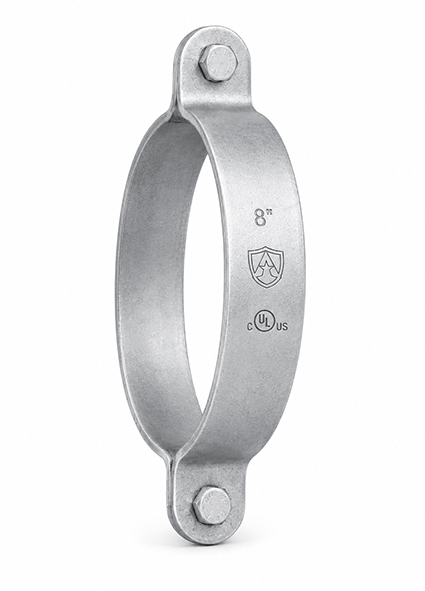
The AquaBarrier Pipe Clamp RL60 is built for suspending cold pipelines. It also works for hot pipelines where insulation is unnecessary.
Its primary product features include:
- Carbon steel construction
- Size range from 1/2″ to 12″
- Black-painted or galvanized finish
- Application for non-insulated cold and hot pipelines
- UL/ULC Listed product information
This extensive size range enables buyers to obtain pipe clamps for various pipe diameters from a single supplier. Black-painted clamps can accommodate many standard indoor applications. Meanwhile, galvanized options offer extra surface protection for tougher environments.
When asking for a quotation, buyers need to provide specific details. Include the NPS or DN, actual pipe OD, and the desired finish. Also state the quantity, application environment, and any project certification requirements.
Conclusion
To select the appropriate pipe clamp, begin with the NPS or DN listed in the project documents. Then, verify the actual pipe OD. Use a trusted size chart or take a physical measurement.
Keep in mind that nominal pipe size does not equal actual outside diameter. An NPS 2 pipe features an OD of 2.375 inches. Conversely, an NPS 6 pipe has an OD of 6.625 inches.
Your final choice must also account for pipe material, load, and temperature. Consider insulation, surface finish, and the installation environment. Also, check applicable engineering standards. Aligning all these factors helps build a safer, more stable, and more resilient piping support system.
FAQs
Is NPS the Same as the Pipe’s Outside Diameter?
No, it is not. NPS functions as a nominal designation. It is not an exact physical measurement. For instance, an NPS 2 pipe possesses an actual outside diameter of 2.375 inches.
Is DN an Exact Diameter in Millimeters?
No. DN also acts as a nominal designation. DN50 aligns with NPS 2. Yet, the standard outside diameter is roughly 60.3 mm instead of 50 mm.
Can One Pipe Clamp Fit Several Pipe Sizes?
Normally, you should use a fixed-size pipe clamp with the specific nominal pipe size and actual OD detailed by the manufacturer. Applying an oversized clamp to a smaller pipe can cause movement or noise. It might also result in uneven loading or a weak installation.


