

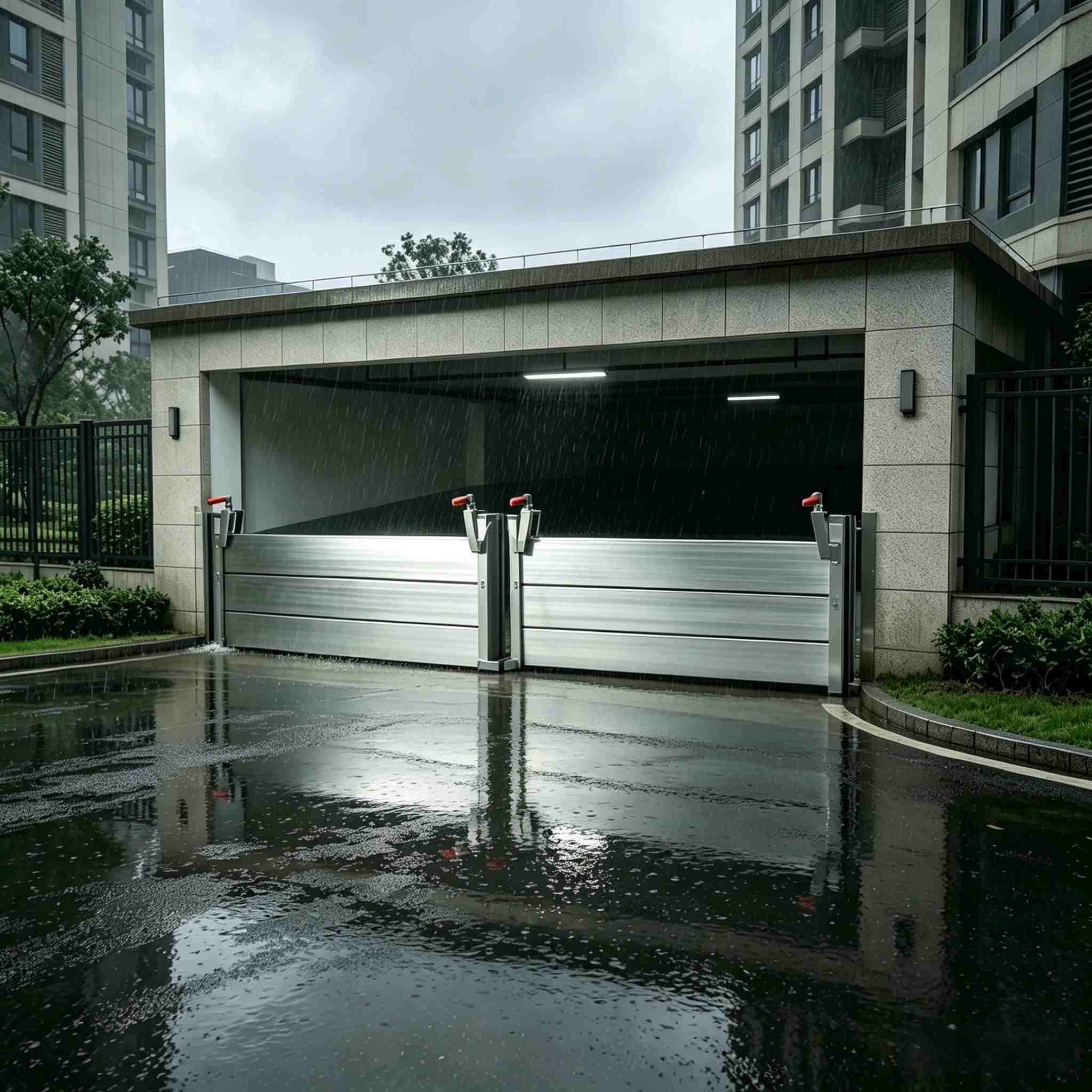
With climate change bringing more frequent and intense weather events, flood protection systems need to be more durable and have less maintenance over time. These barriers can be used for coastal protection or for river protection, to protect industrial sites or urban infrastructure projects. In all cases, the system will be exposed to moisture most of the time and subject to various environmental conditions. In addition, the system may be exposed to aggressive substances that can be corrosive. Therefore, the choice of materials is not only important for the mechanical performance of the system but also for the operational costs over extended periods of time.
Flood control gates have traditionally been made of steel because of its strength and relatively low cost. As the field of materials science is constantly evolving, however, new aluminum alloys have been developed that offer excellent corrosion resistant properties, reduced weight and a host of cost savings throughout the life of the product. 6063-T5 aluminum alloy is the preferred material for aluminium flood barriers, such as for aluminium water barrier systems. A comparison of the corrosion resistant properties of this aluminum alloy and that of steel gates could highlight how modern materials are paving the way for innovative new designs of flood protection.
How Has Materials Science Evolved to Address Corrosion Challenges?
Materials Science has advanced greatly in order to combat corrosion of critical structures such as flood walls and aluminium flood barriers. For systems to be effective as flood protection, the materials used have to resist the constant contact with water and corrosion agents. In this respect, the choice of materials for flood protection is of key importance in terms of structural durability and cost-effectiveness.
The Shift from Traditional Metals to Advanced Alloys
Aluminum alloys have become the engineering materials that have superseded carbon steel as the most suitable for the construction of flood control barriers, and corrosion of these structures is now a thing of the past. While carbon steel is a strong and solid material that is unfortunately however highly susceptible to corrosion by oxidation when in contact with moisture and oxygen, aluminum alloys are corrosion resistant thanks to the high degree of refinement of their microstructure and to the surface treatments which can be given to them. Moreover, their mechanical properties have been significantly improved, and are today the main characteristics taken into account for designing flood control structures. They are light and strong enough to allow good endurance over long periods of time in a humid and/or salty environment, without any significant deterioration.
The Role of Environmental Factors in Material Selection
Environmental exposure is a major factor in the selection of materials for flood protection barrier systems. The exposure to saltwater, humidity and industrial pollutants accelerates corrosion of metal surfaces by promoting electrochemical reactions. Therefore, the selected material for anti-flood barriers must be able to resist corrosion while maintaining its mechanical properties in cyclic wet-dry conditions. Materials able to resist long-term in such environmental conditions will not only increase safety but also provide cost savings by reducing the frequency of coating renewal and structure repair.
What Makes 6063-T5 Aluminum Alloy Distinct in Corrosion Resistance?
6063- T5 aluminum is one of the preferred modern water dam materials because of its unique mixture of strength, machinability and corrosion resistance. The physical properties of this aluminum alloy make it the ideal choice for projects that are exposed to water on a continuous basis, as the aluminum is subjected to severe oxidation.
Composition and Microstructure Characteristics
6063- T5 aluminum is a magnesium / silicon based alloy that contains Mg2Si for excellent corrosion resistance and good extrudability. 6063- T5 has a fine grain size, which enables a uniform anodic oxide layer to form in oxidation processes. This ensures that the surface of a barrier made from 6063- T5 is fully protected. The T5 temper, formed by artificial aging after extrusion, creates a high level of hardness without sacrificing the alloy’s ductility and toughness. The result is a very strong yet highly flexible material.
Protective Mechanisms Against Corrosive Environments
6063-T5 has superior performance over other materials as it forms a stable oxide layer when exposed to air. This passive film is self healing and will continue to protect the base metal from further oxidation even after it has been scratched or abraded. This material will not suffer from pitting corrosion in marine or industrial environments. The surface of 6063-T5 can also be finished by anodizing to increase the thickness of the natural oxide layer. This will allow the material to withstand long term immersion in water or occasional splashing in harsher estuary or coastal environments. A flood protection barrier would benefit from this property.
Why Do Traditional Steel Gates Face Greater Corrosion Risks?
Traditionally, steel gates have been the favored option for flood defense structures, due to the high tensile strength of steel. However, within a corrosive environment, steel gates have several limitations.
Chemical Composition and Corrosion Behavior
Due to the high content of iron in steel it quickly oxidizes in contact with moisture and oxygen. The resulting rust severely endangers the strength of a component. The protective coating of galvanization for example protects against rust for a certain time, however it is worn down continuously by abrasion or in salt water. In weld joints the steel has a different microstructure than in the rest of the component. This microstructural heterogeneity can lead to local galvanic cells. In mechanical stress these corrosion rates are even increased.
Maintenance Demands and Lifecycle Implications
Many traditional steel gates have problems with rusting and will need to be re-painted or re-coated regularly. The corrosion products from the rust can make the gate very heavy and make it harder to open and close. Whilst the savings from not installing an aluminum gate in the first place may be saved in the first year or so, the cost of repeated maintenance will soon eat into these savings and exceed them over extended periods of time.
How Do 6063-T5 Aluminum Flood Barriers Perform Compared with Steel Flood Gates?
When comparing aluminum flood barriers to conventional steel gates on criteria such as load bearing capacity, frequency of required maintenance and adaptability to different environmental conditions, aluminum outperforms on all counts in terms of lifecycle efficiency.
Mechanical Performance Under Load Conditions
The high strength-to-weight ratio of aluminum enables to handle flood barriers easier during installation as well as during emergency deployment without any heavy machinery. In contrast to steel of the same strength aluminum flood barriers are sufficiently rigid to withstand the hydrostatic pressure during a flood. Furthermore the lower mass of aluminum as opposed to steel reduces the mechanical stress on hinges and other components of the support structure in the long term. This results in higher reliability of the system over several decades.
Longevity and Cost Efficiency Over Service Life
Aluminum, with its inherent corrosion resistance, will require less maintenance than a steel counterpart. The higher initial cost of the material will be offset against the lower cost of repairs and extended life, of more than twenty years, for normal situations. Thus the aluminum option will be more cost effective over the life of the material than steel for a sustainable strategy for long term infrastructure.
How Is Aquabarrier Contributing to Reliable Flood Protection Solutions?
Materials Science innovations are being translated into robust engineering solutions for current and future flood defense systems around the world, and Aquabarrier is a case in point.
Commitment to Quality Engineering and Design Innovation
The design philosophy of the Aquabarrier system is based on precision engineered joint connections. These joint connections are designed to ensure that a watertight seal is maintained at all times even under extreme hydrostatic pressure. Every aluminum section of a flood barrier is thoroughly tested for its sealing performance, durability and resistance to corrosion before it is put on the market. Aquabarrier systems are designed to measure up to any requirement and can be specially configured for use in a variety of locations including urban basements and coastal warehouses.
Our flood barriers are constructed with high-strength aluminum alloy. Although very light weight and portable, the products are very strong for their weight and are able to withstand harsh environments and resist corrosion. This allows them to have a longer life span than needed to combat flooding, unlike traditional methods of using sandbags for instance. Our water barriers are very easy to install and require a minimal amount of man hours to complete in a timely fashion. As a result, they can be deployed very quickly to combat a flood of any nature.
Integration of Advanced Materials Science into Product Development
We utilize 6063-T5 aluminum alloy technology as the base for our product range, providing the best possible strength-to-weight ratio in conjunction with long term corrosion protection. We are continuously conducting research to further develop surface treatment, such as the anodizing layer. Our aim is to increase the thickness of the anodizing layer in order to increase the product’s life span even more, already exceeding two decades under normal conditions of use. Research and development of our Aquabarrier products is being conducted by material scientists in conjunction with civil engineers in order to develop products which can be scaled up in order to meet future standards for climate change-resilient infrastructure around the world. The service life of our flood barriers under normal conditions of use exceeds two decades.
What Are the Key Takeaways from Comparing 6063-T5 Aluminum Alloy with Traditional Steel?
A comparison between 6063-T5 aluminum alloy barriers and steel gates reveals a shift in materials engineering from building very durable ‘endurance’ products, to very light ‘resilience’ products that are sustainable.
Comparative Insights on Performance Metrics
The passive surface layer of aluminum, an oxide, is superior for long term stability as opposed to the reactive surface of steel that rusts. The less frequency of required maintenance translates into lower life cycle costs and high reliability over long life for aluminum as opposed to steel. Also, aluminum is very recyclable thus reducing its environmental impact and the lower amount of required maintenance decreases consumption of resources over time. This fits well into the sustainability goals for the whole world as it reduces the consumption of resources needed for repainting and replacement of components that is typical for steel based structures.
Conclusion: Advancing Flood Protection Through Material Innovation
Modern materials science has enabled the shift from traditional steel gates to high-quality 6063-T5 aluminium flood barriers. These new developments of flood control barrier systems are not only technically optimized but also economic efficient. Companies like Aquabarrier work in the field of water barrier systems made of high-quality aluminum for urban flood protection on a global scale. They are constantly developing up-to-date water barrier technologies for future urban flood protection needs. These innovative systems are designed to be highly efficient and to provide optimal protection in case of flooding.
FAQs
1. Why is 6063-T5 aluminum preferred over steel for flood barriers?
Aermet alloy has excellent corrosion resistance as a result of the oxide layer on the surface and at the same time it is strong enough to withstand heavy usage and is much lighter than steel for the same strength.
2. Does anodizing improve the durability of aluminum flood barriers?
Anodizing thickens the natural oxide layer on aluminum surfaces and as a result increases wear resistance and extends service life.
3. How often do aluminum flood barriers require maintenance compared with steel gates?
The aluminum barriers need very little maintenance, a periodic check is all. In contrast to steel gates that require frequent repainting or recoating because of rust.
4. Are there any environmental benefits associated with using aluminum instead of steel?
Yes, as aluminum can be recycled this reduces the environmental impact and as this material has low maintenance needs this then reduces the overall resource consumption over time.
5. What distinguishes Aquabarrier products from other suppliers’ offerings?
The flood barrier system Aquabarrier is made from high quality aluminum by use of the latest material technology combined with high precision manufacturing.


