
Beam clamps and lifting beam clamps might seem like identical items, but they tackle totally distinct tasks. People often utilize one to form a firm anchor point on structural steel for support frameworks. Meanwhile, manufacturers build the other specifically to lift, hoist, or rig heavy loads. Picking an incorrect model can cause mounting issues. More crucially, it creates severe safety hazards. You might be setting up pipe supports, handling an MEP project, or picking out rigging gear. In any case, understanding the contrast between a beam clamp and a lifting beam clamp proves vital before you submit an order.
What Is a Beam Clamp Used For?
Workers normally apply a standard beam clamp to establish an anchor spot on a steel framework. This method avoids the need for a traditional welded joint. You will frequently spot it in building services, pipe support systems, and mechanical setups. It also appears in various other structural support tasks.
How Does a Standard Beam Clamp Work?
A beam clamp usually holds onto the flange or edge of a steel component. It does this by utilizing a screw or a comparable locking device. Based on the item’s layout, you can attach it to the top or bottom flange of a beam.
Certain versions can also fasten to alternative structural shapes. These include purlins, channels, and angle iron. This versatility makes beam clamps quite handy. Installers often require a convenient anchor spot while handling existing steel structures.
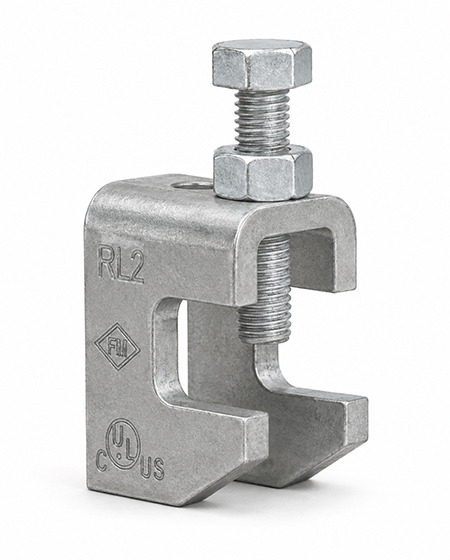
For instance, the AquaBarrier Beam Clamp RL2 is crafted for structural fastening. You can secure it to the top or bottom of metal beams, purlins, channels, or angle iron. It comes in 3/8″ or M10 sizes. It incorporates Q235B carbon steel and is available with black or galvanized finishes.
What Is a Lifting Beam Clamp Used For?
Even though they share a similar title, a lifting beam clamp fits into a separate usage group. Makers construct these items as anchor spots for lifting and rigging tasks.
Why Is a Lifting Beam Clamp Different?
A lifting beam clamp is normally fastened to a structural beam. This setup allows lifting gear, like a hoist or another rigging tool, to link to it. Depending on its layout, it can act as a short-term or semi-permanent hoisting point.
This tool is meant to bear suspended weights during hoisting tasks. Therefore, you must pick a lifting beam clamp based on several details:
- Rated lifting capacity
- Beam flange dimensions
- Loading direction
- Clamp adjustment range
- Rigging configuration
- Manufacturer instructions and applicable safety requirements
An item designed purely for structural fastening should never automatically be treated as lifting equipment. This rule holds true even if it attaches to a beam.
What Is the Difference Between a Beam Clamp and a Lifting Beam Clamp?
The simplest method to tell the two apart is to look at what occurs after you mount the clamp. Their titles might be alike, yet their intended loads and uses definitely are not.
Beam Clamp vs Lifting Beam Clamp at a Glance
| Feature | Standard Beam Clamp | Lifting Beam Clamp |
| Main purpose | Structural/support attachment | Lifting and rigging |
| Typical applications | Pipe supports, building services, support systems | Hoists, rigging and load lifting |
| Attachment location | Steel beams, purlins, channels or angle iron, depending on model | Usually structural beam flanges |
| Load requirement | Depends on support application and product rating | Requires defined lifting capacity |
| Used as a hoisting point? | Not unless specifically approved for that purpose | Yes, when correctly selected and installed |
Therefore, the most crucial difference is not how the clamp looks. Instead, it is its manufacturer-defined purpose and rating.
Can You Use a Regular Beam Clamp for Lifting?
This stands as one of the most vital questions shoppers and installers must ask. Two clamps might appear alike. However, they can possess entirely distinct design criteria.
Why Should the Products Not Be Interchanged?
You should not utilize a standard structural beam clamp for hoisting. The only exception is if its maker clearly declares that it is built, tested, and rated for that specific task.
Hoisting brings in forces and safety rules that can differ greatly from those in a static support framework. Utilizing an unrated structural mount as a lifting spot can create huge dangers. It might expose the clamp, beam, gear, and workers to unacceptable risks.
The reverse idea applies as well. Buying a heavy lifting clamp for a basic building-services mount can bring unneeded expense, weight, and mounting trouble.
Always pick the clamp based on its planned use, rather than relying solely on its title.
Which Beam Clamp Should You Choose for Your Project?
Before purchasing a beam clamp, begin with the exact job you need it to do. This step swiftly removes items that fit into the incorrect group.
What Should You Check Before Ordering?
For structural fastening tasks, think about:
- Supporting structure: Are you attaching to a beam, purlin, channel, or angle iron?
- Mounting position: Will the clamp connect to the top or bottom of the steel section?
- Connection size: Confirm the required imperial or metric size, such as 3/8″ or M10.
- Material: Check whether the clamp material is appropriate for your project.
- Surface finish: Consider environmental conditions when choosing between available finishes.
- Project requirements: Verify specified loads, installation instructions, and engineering requirements before use.
For hoisting tasks, select only gear expressly built and rated for lifting or rigging. Furthermore, adhere strictly to the lifting equipment manufacturer’s guidelines.
Where Can You Find a Reliable Beam Clamp Supplier?
Item reliability is crucial when you buy beam clamps for building, MEP, pipe support, or seismic bracing jobs. Shoppers might also require steady specs, proper finishes, clear technical chat, and a trustworthy supply chain.
Why Consider AquaBarrier for Beam Clamps?
AquaBarrier provides structural fastening and support items for engineering and building tasks. Its product lineup covers beam clamps, pipe clamps, seismic sway bracing parts, hangers, and various support-system add-ons.
The Beam Clamp RL2 offers a handy choice for structural mounting to metal beams, purlins, channels, and angle iron. It comes with 3/8″ and M10 choices, along with black or galvanized finishes. Thus, buyers can pick a setup that fits their project needs.
For builders, sellers, and project buyers, AquaBarrier can also offer item advice when you are picking out proper support-system parts.
How Can You Make the Right Choice?
You should not apply the phrase “beam clamp” as a general term for every clamp fixed to structural steel. The actual task must always take priority.
Conclusion
A standard beam clamp is usually meant to form a structural anchor spot for support-system tasks. On the other hand, a lifting beam clamp is specially crafted to offer a hoisting or rigging point.
Suppose your job entails pipe supports, building services, or structural mounts on beams, purlins, channels, or angle iron. In that case, an item like the AquaBarrier Beam Clamp RL2 might fit well, once you check the needed specs. If the task involves hoisting or hanging loads via lifting gear, select a purpose-built lifting beam clamp that has the proper rated capacity.
Never swap one sort for the other without clear maker consent. Proper item choice safeguards both mounting success and workplace safety.
FAQs
1. Is a Beam Clamp the Same as a Lifting Beam Clamp?
No. A standard beam clamp is normally built for structural or building-services mounts. Meanwhile, a lifting beam clamp is crafted for hoisting and rigging jobs. Always verify the maker’s stated purpose and ratings before utilizing them.
2. Can I Use the AquaBarrier Beam Clamp RL2 for Lifting?
AquaBarrier lists the Beam Clamp RL2 as a structural attachment for metal beams, purlins, channels, and angle iron. You should not treat it as lifting gear unless AquaBarrier specifically supplies a lifting rating and approval for that planned task.
3. Is M10 the Same as a 3/8″ Beam Clamp?
No. M10 represents a metric dimension, whereas 3/8″ acts as an imperial dimension. Even though their stated widths are fairly similar, their thread rules differ. AquaBarrier supplies the RL2 in both 3/8″ and M10 choices. Therefore, shoppers should pick the type that aligns with the required joint and project needs.