
People increasingly use flood barriers to guard garages, warehouses, commercial entrances, gardens, and other at-risk openings against rising water. Still, not every doorway needs the exact same setup. A major choice is whether to pick a fixed-width flood barrier built for a set space or an expandable flood barrier. This second type can stretch across wider or changing areas. Making the correct choice impacts the installation process, sealing quality, and daily use. It also affects long-term flexibility and total project costs. Property owners, facility managers, contractors, and distributors should compare these two designs before they buy. Doing this helps them avoid useless changes. It also builds a much better flood protection system.
What Is the Difference Between Fixed-Width and Expandable Flood Barriers?
Both setups aim to form a short-term physical block against incoming floodwater. However, their structural designs and best uses differ quite a bit.
How Does a Fixed-Width Flood Barrier Work?
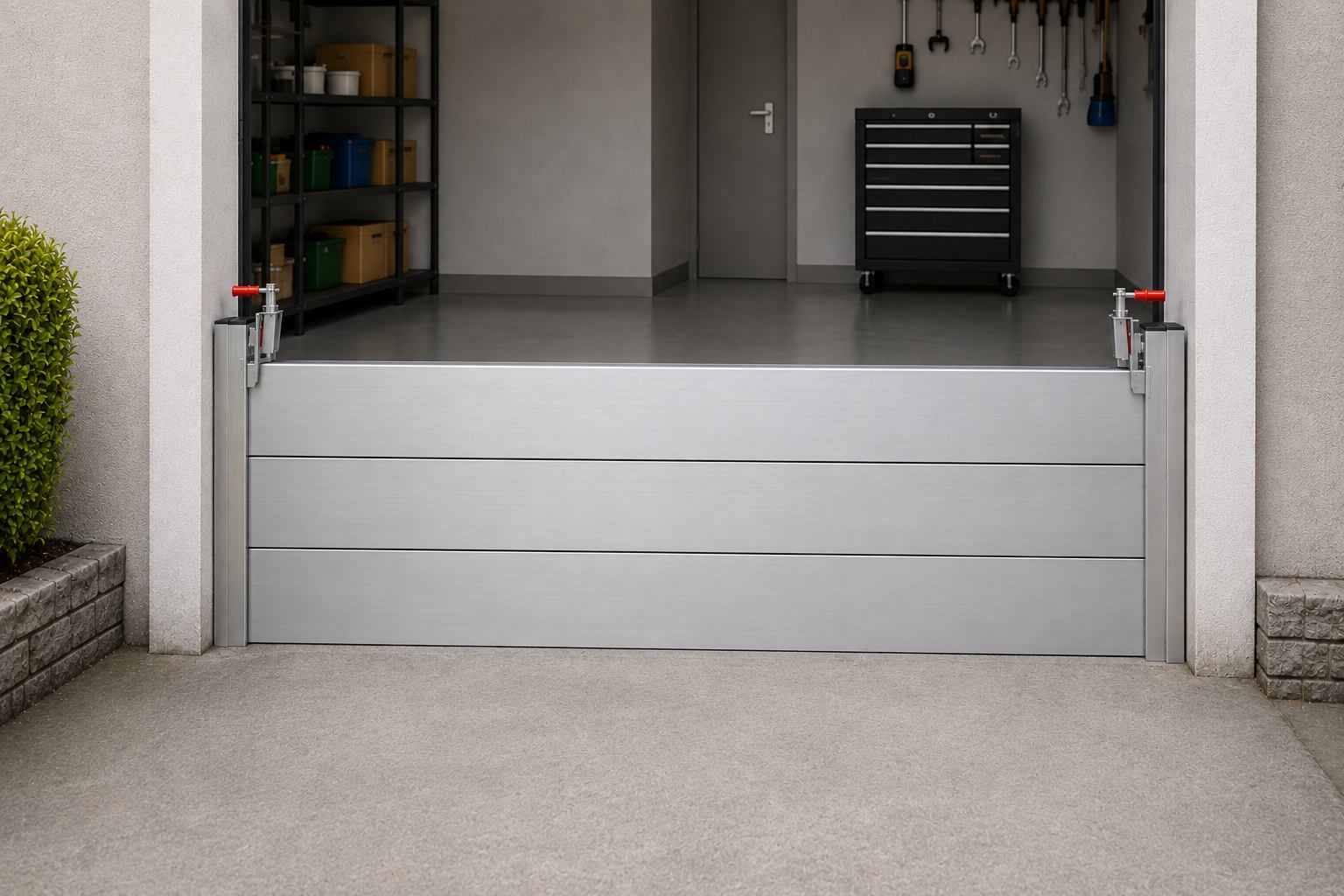
Makers build a fixed-width flood barrier for one specific opening. Workers usually place supporting columns at both ends. Then, the barrier panels cross the set distance right between these columns.
Aquabarrier’s Flood Barrier-S670 uses this exact idea. Based on the product details, the S670 fits fixed-width gaps. Installers secure its columns to the walls on both sides. The standard layout measures roughly 1.95 m × 6.70 m.
This setup works very well when you already know the gap sizes. It is also great if those sizes will not change later. Once workers lock in the mounting spots, people can put up the barrier in that exact spot over and over.
How Does an Expandable Flood Barrier Work?
An expandable flood barrier relies on a modular layout. It does not limit the setup to just one strict length. Instead, users can link extra barrier parts together. This adds to the total protected width.
Aquabarrier’s Flood Barrier-F303 takes this flexible path. Installers fix one end to the wall. Meanwhile, the other side can link up with extra F303 units. Because of this, the barrier can stretch across bigger or changing gaps. The maker lists this setup as roughly 1.95 m × (3.2 + 3.2 + n) m.
This makes expandable setups highly useful for places with changing gap widths. They also shine when one flood defense system must shield a massive area.
When Is a Fixed-Width Flood Barrier the Better Choice?
Fixed-width setups are usually the most sensible pick for clearly marked gaps. They are ideal if the space will never need to grow wider in the future.
Which Properties Benefit Most From a Fixed Configuration?
A garage door, service entry, or warehouse gate often fits a fixed-width flood barrier perfectly. A clear walkway between two solid walls is another great spot for this type.
The mounting spots stay exactly the same over time. Therefore, builders can shape the barrier to fit the true gap size. This makes planning the setup much easier. It also makes putting the barrier up again a breeze.
For buyers, getting exact site measurements is vital. They must check the gap width, shield height, and wall health before starting. They should also look at the floor level and the open mounting space. Aquabarrier’s setup guide points out a few extra details. It tells users to check wall strength, door swing direction, barrier height, and barrier width to find the safest layout.
A fixed setup therefore works best under stable site conditions. It is the top choice when a buyer wants a focused tool for just one specific door.
When Does an Expandable Flood Barrier Make More Sense?
Some sites cannot get good protection from a single fixed span. Industrial and commercial spots often have much wider gaps. They might feature changing layouts or zones where multiple barrier parts must link up.
Why Are Modular Systems Useful for Large Openings?
Warehouses, loading docks, factory gates, and parking lots face unique risks. Wide access roads also face these threats. They might need much longer flood defense lines than a normal door.
An expandable flood barrier lets users add extra modules for greater width. This drops the need to build one giant, single-piece wall. It also gives project planners more freedom when securing odd-shaped spaces.
The F303 layout relies totally on this modular idea. Extra units can stretch the system without stopping. This makes it a better match for odd-sized gaps.
Expandable models offer great value for distributors or contractors on different jobs. A modular system brings a lot of freedom when project sizes change from day to day.
Which Design Is Easier to Install and Deploy?
Setup ease depends very little on whether a barrier is fixed or expandable. Instead, it relies mostly on how well the system matches the actual site.
What Should Be Checked Before Installation?
For either design, workers must first check the walls, floor, and mounting spots. They also need to look at the doorway base and the likely flood path. Exact measurements are a must. Even a tough flood barrier will fail if water slips through gaps at the edges.
Fixed-width barriers often feel simpler after drilling the permanent mounting holes. Users just put the very same panels back into the exact same gap.
Expandable barriers bring in more parts as the protected width grows. Because of this, clear labels and neat storage become very important. A well-planned assembly order matters a lot, too.
Large commercial sites should run a test setup before the rainy season hits. This helps workers see where each part goes. It also lets them spot missing bolts or broken seals long before a real crisis hits.
How Do Materials and Sealing Affect Both Designs?
The basic frame is just one piece of the flood barrier puzzle. The raw materials and sealing parts also play a massive role in success.
Why Are Aluminum Alloy, Stainless Steel, and Rubber Commonly Used?
Aquabarrier’s flood barrier lineup mixes aluminum alloy, stainless steel, and rubber. The maker points out rust resistance and tough frames as major perks. They also highlight the watertight sealing of this material blend.
Aluminum alloy keeps the loose panels light and easy to carry. At the same time, it offers solid strength. Stainless steel works well for heavy-duty support or linking parts. Meanwhile, rubber seals close up the tiny spaces between panels, walls, and the floor.
It does not matter if the system is fixed-width or expandable. Buyers must check the sealing edges often. Dirt, bent parts, torn rubber, or badly placed panels will weaken the defense.
Which Flood Barrier Offers Better Flexibility and Long-Term Value?
The better pick rests entirely on whether the property truly needs future flexibility.
Should Buyers Pay for Expandability They May Never Use?
Suppose a building has a single permanent door with stable sizes. Here, a fixed-width barrier offers a simpler, more direct fix. There is no real point in paying for modular add-ons if the system will always cover the exact same gap.
On the flip side, an expandable barrier brings better long-term value to warehouses and industrial plants. Large garages and changing properties also gain from this. Extra modules let the flood defense line grow. This saves the owner from buying a totally new system later.
Buyers must therefore look past the upfront price tag. They should weigh the setup steps, growth plans, storage space, and labor needs. Routine upkeep and the price of future changes also matter a lot.
How Can You Choose Between S670 and F303?
Making this choice gets much easier once you clearly define the door type and future needs.
Which Model Matches Which Application?
Go with a fixed-width system such as the Flood Barrier-S670 for stable gaps. It works best when you have strong walls on both sides and no plans to expand later.
Pick an expandable system such as the Flood Barrier-F303 for wider doors. It is also smart if sizes change or if you might need extra parts to stretch the defense line.
Both tools work well for warehouses, gardens, and garages. Therefore, the building type is not the main deciding factor. The shape of the risk zone and the needed barrier width matter far more.
Why Choose Aquabarrier as a Reliable Flood Barrier Supplier?
Aquabarrier delivers solid flood barrier tools for homes, shops, and factories. Its product lineup holds both fixed-width and expandable models. This lets buyers pick the right system based on actual door sizes and site details.
Aquabarrier flood barriers rely on aluminum alloy, stainless steel, and rubber parts. Workers can custom-fit these pieces to meet specific job needs. The company also gives helpful advice and setup tips. This support proves very handy when contractors or owners must figure out the right sizes, mounting methods, and layouts before buying.
Conclusion
No single flood barrier style works perfectly for every building. A fixed-width flood barrier usually fits best on clear, steady gaps where sizes never shift. Meanwhile, an expandable flood barrier grants much more freedom for wide, odd, or changing zones.
Before picking between the two, buyers must check the gap width and the needed shield height. They should also look at wall health, floor smoothness, and open mounting spots. Usage rates, storage space, and future growth plans are vital too. Matching the barrier to the real site works better than just grabbing the biggest model. This careful approach creates a highly useful and smooth flood defense system.
FAQs
What is the main advantage of a fixed-width flood barrier?
Builders shape a fixed-width flood barrier for one specific gap. This makes it a great match for garages, standard doors, and similar spots. It shines where the gap width stays the same and users put the barrier in the exact same spot every time.
Can an expandable flood barrier protect very wide openings?
Yes. Modular expandable setups can link extra parts to boost the total shielded width. Planners must still design the full layout based on site health. They must also check the mounting limits and the likely flood water pressure.
Should I choose S670 or F303 for a warehouse?
It depends mostly on the doorway rather than the warehouse itself. The S670 fits best when the gap has a steady width and strong walls on both sides. The F303 makes more sense for wider gates. It is also better when you might need extra barrier pieces to stretch the flood defense line.